

Kleingruppentour durch Nordlichter
From ISK 13990

 Deutsch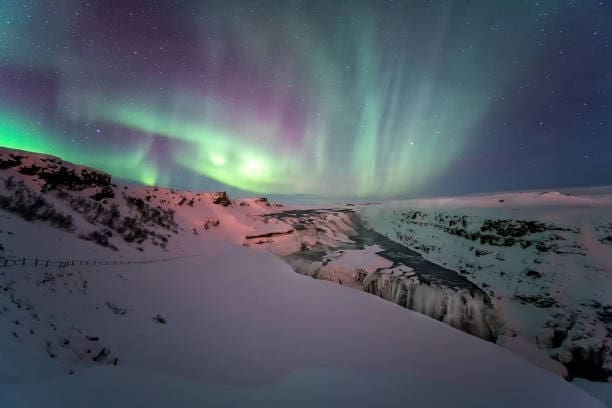
Few natural spectacles rival the northern lights — and Iceland is one of the best places on Earth to witness them. Sitting just below the Arctic Circle, the entire country falls within the auroral zone, which means that on a dark, clear night with the right conditions, the sky can erupt in shifting curtains of green, purple and pink. This complete guide covers when to go, where to look, how to read the forecast and how to give yourself the best possible chance of seeing the aurora borealis.
The northern lights, or aurora borealis, occur when charged particles from the sun collide with gases in the Earth’s upper atmosphere. These collisions release energy as light, and the Earth’s magnetic field funnels the activity toward the poles — which is why high-latitude countries like Iceland are prime viewing territory. Green is by far the most common colour, produced by oxygen, while strong displays can add purples, reds and pinks.
The aurora is actually present year-round, but you can only see it when the sky is dark. That makes the season run from roughly late August/early September to mid-April, when Iceland’s nights are long enough. The darkest months — from October to March — offer the most hours of potential viewing.
Crucially, the lights are not visible during the summer (May to mid-August), because the midnight sun keeps the sky too bright. If the northern lights are your main goal, plan a trip in autumn, winter or early spring. For a season-by-season overview of everything else Iceland offers, see our guide to the best time to visit Iceland.
There’s no exact hour the aurora appears, but activity is often strongest between 9pm and 2am. That said, the lights can show up any time the sky is dark, so it pays to keep checking through the evening. Displays can last anywhere from a few fleeting minutes to several hours, sometimes fading and then surging back, so patience is rewarded.
Seeing the aurora comes down to three things lining up:
The Icelandic Meteorological Office publishes a free aurora forecast that combines predicted auroral activity with a cloud-cover map. The trick is to look for areas with low cloud cover and decent activity — sometimes that means driving 30–60 minutes to escape the clouds. Check the forecast daily during your trip and stay flexible; a clear gap in the weather can appear at short notice.
You want darkness and an open view to the north. Great options near the capital include the countryside around Þingvellir and the Golden Circle, the Reykjanes Peninsula, and rural areas along the south coast. On nights of strong activity you can even catch the lights from the edges of Reykjavík — head to a dark park or the shoreline away from streetlights.
A guided northern lights tour takes the guesswork out of it: experienced guides track the forecast in real time and drive you to wherever the skies are clearest that night, which dramatically improves your odds compared with staying put.
A few free resources make aurora hunting far easier. The Icelandic Meteorological Office’s aurora page pairs a cloud-cover map with an activity forecast and is the local standard. Several aurora-alert apps will notify you when conditions spike, and a good weather app helps you find clear-sky windows. Keep an eye on the KP-index forecast too — but remember that on the ground, clear, dark skies often matter more than a high KP reading. The best “tool” of all is flexibility: be ready to head out at short notice when the clouds part.
No one can guarantee the aurora — it depends on nature. That’s why many guided tours offer a free second attempt if the lights don’t appear on your trip. The honest advice is to treat the northern lights as a magical bonus, build a few chances into your itinerary, and enjoy Iceland’s other winter wonders — like glaciers and ice caves and geothermal lagoons — regardless of what the sky does.
The aurora’s palette is a direct readout of physics happening 100 kilometres or more above your head. The familiar green — the most common colour by far — comes from oxygen molecules at altitudes of around 100–300 km. Higher up, oxygen can glow a rare, deep red, while nitrogen produces blues and purples, often seen along the lower fringes of an active display. The most dramatic shows blend several colours at once, rippling and folding like a curtain in the wind. The intensity and colour mix depend on how much solar energy is hitting the atmosphere and which gases it’s exciting, which is why no two displays ever look quite the same.
Long before scientists understood the solar wind, the northern lights filled the human imagination. Norse tradition sometimes linked the shimmering lights to the Bifröst bridge connecting the mortal world to the realm of the gods, or to the armour of the Valkyries glinting as they rode across the sky. Other Nordic folk beliefs held that the lights were the spirits of the departed, or even reflections from vast shoals of herring. In Iceland, one old superstition warned pregnant women not to look at the aurora, lest it affect their child. These stories are a reminder that the spectacle you’re chasing has stirred wonder for many centuries — you’re joining a very long line of sky-watchers.
A camera can capture colour and detail that the naked eye struggles to see in the dark, so even a modest display can produce stunning photos. The essentials are a camera that allows manual settings, a sturdy tripod (long exposures are impossible handheld), and a wide-angle lens with a wide aperture. As a starting point, try an aperture around f/2.8, an ISO between 800 and 3200, and a shutter speed of 5–15 seconds — shorter for fast-moving, bright aurora and longer for faint glows. Set focus manually to infinity, use a 2-second timer or remote to avoid camera shake, and bring spare batteries, as the cold drains them quickly. Modern smartphones with a dedicated night mode can also produce surprisingly good results when braced on a steady surface or a small tripod.
From roughly late August/early September to mid-April, when the nights are dark enough. The darkest and most reliable months are October through March. They cannot be seen in summer because of the midnight sun.
Activity is often strongest between about 9pm and 2am, but the aurora can appear any time the sky is dark. It’s worth checking the sky repeatedly throughout the evening.
Anywhere dark with a clear view and minimal light pollution. Popular spots include the Þingvellir/Golden Circle area, the Reykjanes Peninsula and the rural south coast. Guided tours chase the clearest skies on the night.
Yes, on nights of strong activity, especially from darker spots away from streetlights such as parks or the shoreline. However, leaving the city for darker surroundings gives a much better view.
There are no guarantees, but the more nights you try, the better your odds. Plan for at least three nights during aurora season to give yourself a strong chance.
Not necessarily — you can see them on your own with a car and a good forecast. But a guided tour improves your chances, since guides track conditions in real time and drive to the clearest skies, and many offer a free repeat trip if the lights don’t show.
Ready to chase the aurora? Explore our northern lights tours and let our local guides find the clearest skies for you.